


This is not just another enterprise agreement.
It is one of the most significant opportunities in a generation to:
restore the value of allied health care.
Everything has led us to this moment:
the Fair Work Commission’s gender undervaluation decision
the 28% nursing wage increase
rising inflation and cost-of-living pressures
wage increases of up to 33% for paramedics
and an upcoming state election.
This is our opportunity. But it will only happen if members stand together.
Be ready. Be prepared. Be aware.
Any offer must be judged against what is needed to restore our wages; not simply by whether it sounds like a large percentage or compares favourably with another profession.
Last time, members were told that 2% was a “good deal.”
We know where that left us.
This time, we may again be told that we should accept less than what is needed because it compares favourably with another profession.
But if we are serious about restoring our wages and putting allied health back on a trajectory alongside nursing, our claim is clear:
36.18%. Not a percent less.
And it needs to be delivered within the timeframe we have claimed.
Our claim
• 18.5% backdated to 1 March 2026
• 5% on 1 March 2027
• 5% on 1 March 2028
• 7.68% on 27 November 2028
Accepting a smaller increase over a longer period (particularly without back pay) would delay the recovery of our wages for years while inflation continues to erode our purchasing power.
Look at what has already happened:
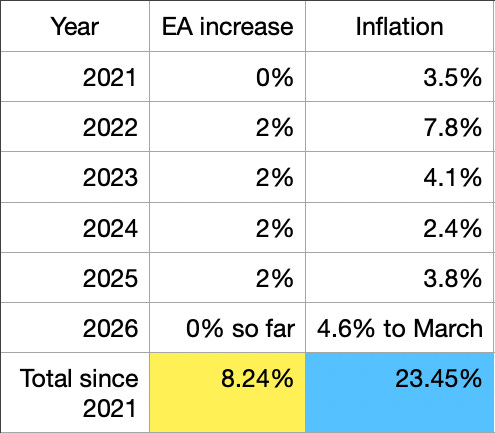
Since 2021, our wages have increased by only 8.24% cumulatively through the previous EA increases, while prices have risen by approximately 23.45%.
That represents a substantial loss in purchasing power.
After a global pandemic, allied health professionals should be more valued, not less.
We are asking to begin restoring the purchasing power we had in the 2010s… not signing up for another decade of going backwards.
So what does 36.18% actually mean?
It isn’t about getting ahead.
It is about catching up.
The 18.5% backdated component is critical because it begins addressing the purchasing power members have already lost.
And this is important:
The claim is not simply about gender undervaluation.
The Fair Work Commission’s findings provide an important basis for addressing the historical undervaluation of our work. But allied health professionals have also experienced years of wage increases that have failed to keep pace with the cost of living.
We cannot separate those issues from the reality members experience every day.
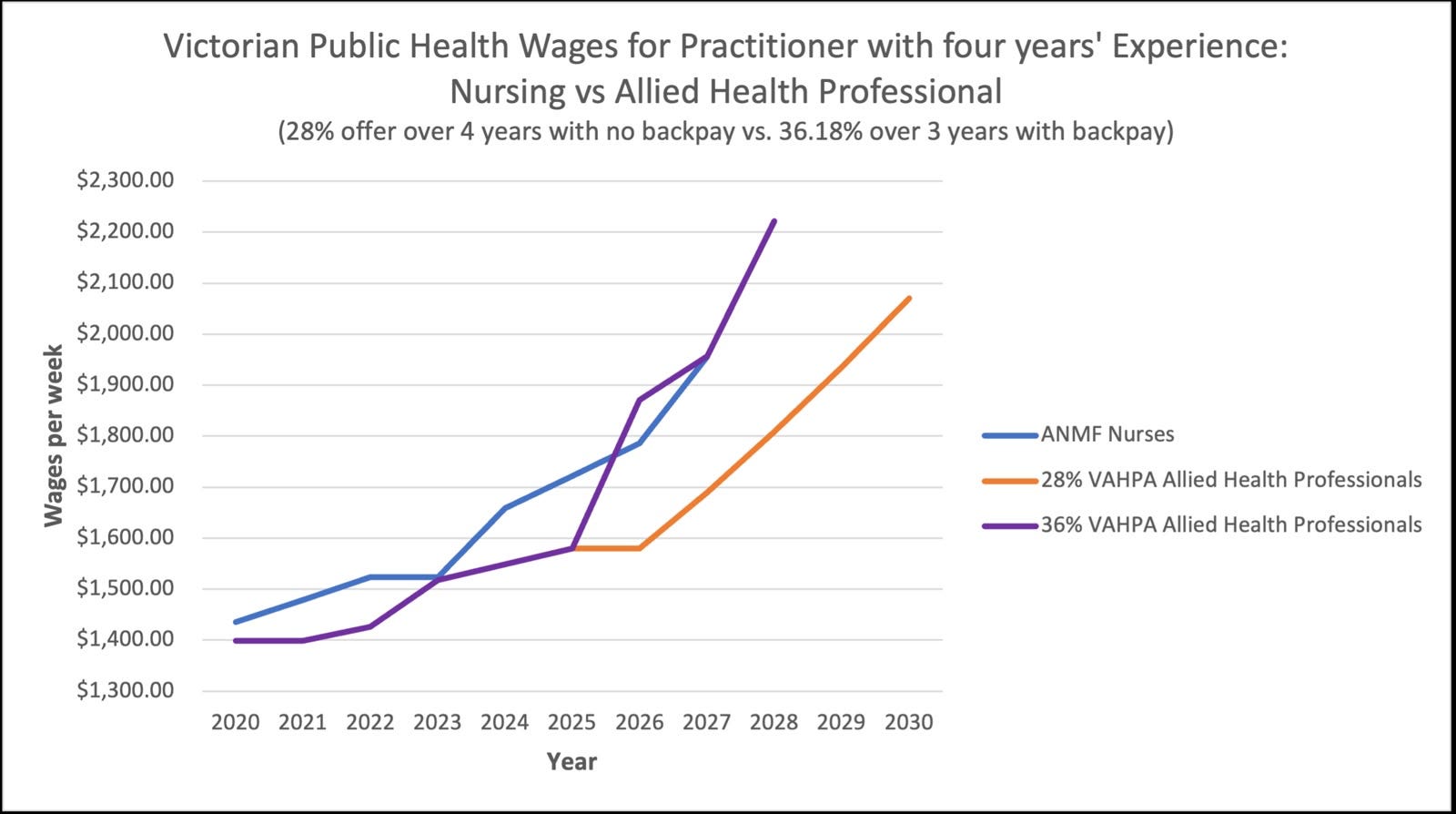
The graph above illustrates the gap between a hypothetical 28% increase and our 36.18% claim, alongside the increase achieved by nurses at an equivalent level of experience.
28% might sound good.
But the question isn’t:
“Is 28% a good pay rise?”
The question is:
“Is it enough to restore the value of allied health care?”
Our answer is clear.
No Less Than 36.18%.
This is the moment to hold the line.
Stand together. Stay united. Be prepared.
Because if we accept an offer that falls short of what is needed to restore our wages, we risk locking in another period of falling behind.
And we haven’t even discussed the essential workload and classification claims that are also part of this bargaining process.
36.18% is not about getting ahead.
It is about catching up.
No Less Than 36.18%.
Inflation Data Source: https://www.abs.gov.au/media-centre/media-releases/cpi-rose-46-year-march-2026?utm
Connect with us
Visit our website, instagram, facebook, substack and share with your colleagues.
Comment, like, get in touch with us if you want to get involved and join the fight!
Leave questions on our socials or via our website portal for us to answer in Q&A.
How do I vote? click here for How to vote Pulse
Remember, when it’s time to vote, VOTE VAHPA Pulse to make sure your voice is heard!
